


FROZEN SHOULDER AYURVEDA TREATMENT: RELIEVE PAIN & RESTORE MOBILITY NATURALLY
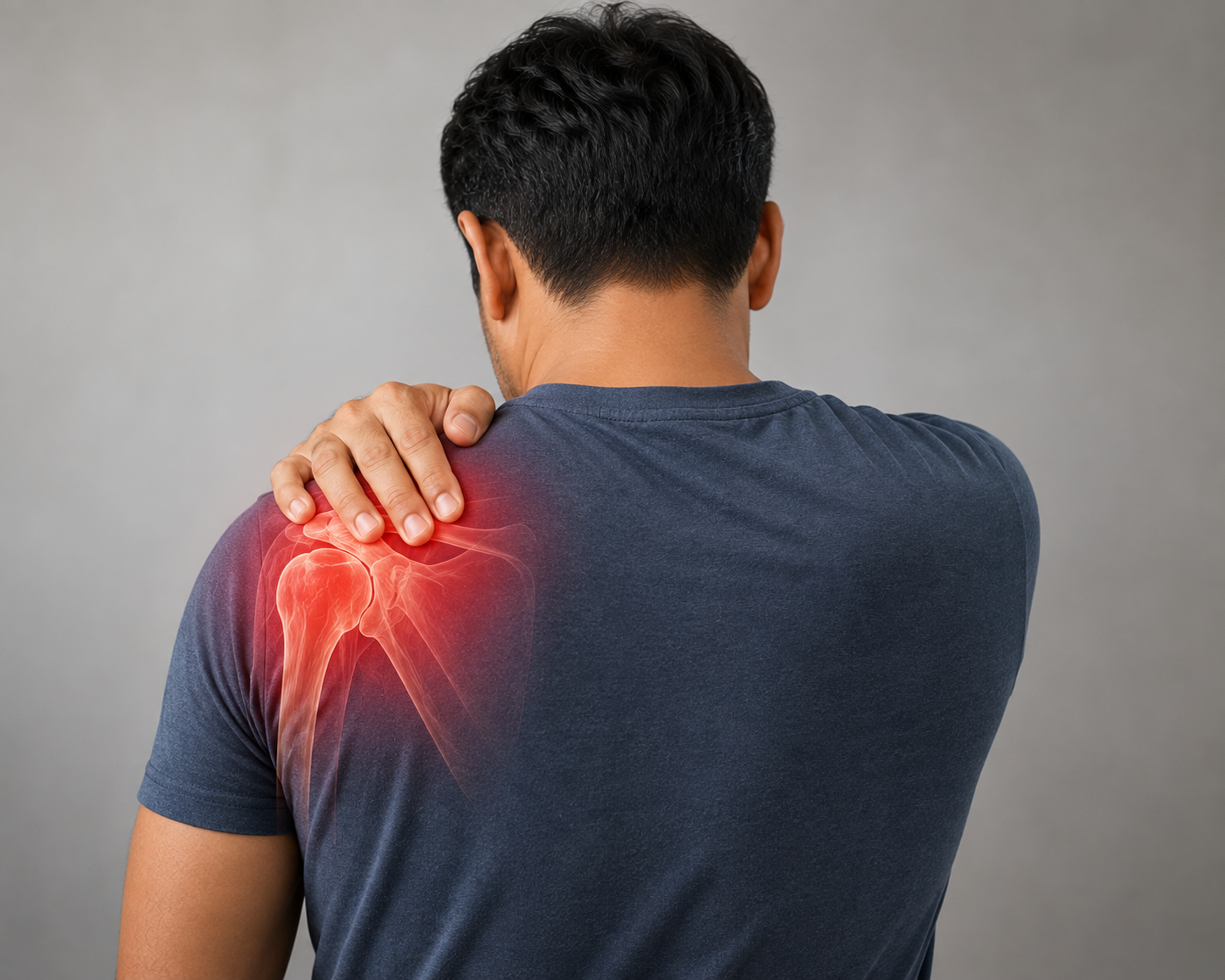
Frozen Shoulder (Adhesive Capsulitis)
Frozen shoulder, medically known as adhesive capsulitis, is a painful condition that causes stiffness and restricted movement in the shoulder joint. It develops when the connective tissue surrounding the shoulder joint, called the shoulder capsule, becomes thickened, tight, and inflamed.
Over time, thickening and fibrotic adhesions within the shoulder capsule can progressively restrict joint movement and reduce the range of motion. This may make daily activities such as dressing, reaching overhead, and sleeping on the affected side difficult. Frozen shoulder typically develops gradually, and the recovery period may range from several months to a few years, depending on the individual and the severity of the condition.
Understanding the Shoulder Joint
The shoulder is a ball-and-socket joint that allows a wide range of motion. It is made up of three main bones:
- Humerus – Upper arm bone
- Scapula – Shoulder blade
- Clavicle – Collarbone
The rounded head of the humerus fits into a shallow socket in the scapula. Surrounding this joint is the shoulder capsule, a strong connective tissue structure that stabilizes the joint.
To allow smooth and pain-free movement, the capsule is lubricated by synovial fluid, which reduces friction between the joint surfaces.
What Happens in Frozen Shoulder?
In frozen shoulder:
- The shoulder capsule becomes thickened and stiff
- Adhesions (thick bands of tissue) form
- The amount of synovial fluid decreases
This leads to:
- Severe shoulder pain
- Significant restriction in movement
- Difficulty performing daily activities
Both active and passive shoulder movements become painful and restricted.
Ayurvedic Perspective on Frozen Shoulder (Apabahuka)
In Ayurveda, frozen shoulder is referred to as Apabahuka. It primarily affects the Amsa Sandhi (shoulder joint) and is mainly caused by an imbalance of Vata Dosha.
Apabahuka presents with symptoms such as:
- Shoulder pain (Amsa Shoola)
- Stiffness (Amsa Stambha)
- Restricted shoulder movements
- Weakness (Bala Kshaya)
These symptoms closely resemble the clinical presentation of frozen shoulder.
Causes According to Ayurveda
Several factors contribute to the aggravation of Vata Dosha, including:
- Exposure to cold (Sheeta)
- Improper posture or overuse of the shoulder
- Aging (Vaya Vriddhi)
- Trauma (Abhighata)
- Chronic illnesses such as Diabetes Mellitus
Ayurvedic Understanding of Disease Progression
According to Ayurveda, aggravated Vata leads to the following:
- Tissue depletion (Dhatu Kshaya)
- Blockage of body channels (Srotorodha)
- Reduction in joint lubrication due to Shleshaka Kapha Kshaya
As a result, the shoulder becomes painful, stiff, and difficult to move.
Symptoms of Frozen Shoulder
Common symptoms include:
- Persistent shoulder pain
- Stiffness and reduced range of motion
- Difficulty performing everyday activities such as dressing or reaching overhead
- Pain that worsens with shoulder movement
- Inability to move the shoulder normally, even with assistance
Pain is usually dull or aching in nature and is often more severe during the early stage of the condition.
Stages of Frozen Shoulder
Frozen shoulder usually progresses through three stages.
1. Freezing Stage
- Gradual onset of shoulder pain
- Increasing stiffness and reduced movement
- Pain worsens over time
Duration: 6 weeks to 9 months
2. Frozen Stage
- Pain may gradually decrease
- Stiffness remains severe
- Daily activities become difficult
Duration: 4 to 6 months
3. Thawing Stage
- Gradual improvement in movement
- Slow return of flexibility and strength
Duration: 6 months to 2 years
Causes and Risk Factors of Frozen Shoulder
Frozen shoulder develops when the shoulder capsule becomes inflamed, thickened, and tight. Scar tissue (adhesions) may form, reducing lubrication within the joint and making movement painful and restricted.
Although the exact cause is not always known, several factors increase the risk.
Common Risk Factors
- Age: Most common between 40–60 years
- Gender: More common in women
- Diabetes Mellitus: Increased risk in diabetic patients
- Injury or Surgery: Fractures, rotator cuff injuries, or surgery requiring prolonged immobilization
- Prolonged Immobilization: Use of slings or reduced movement after injury
- Other Medical Conditions:
- Hypothyroidism
- Hyperthyroidism
- Parkinson’s disease
- Heart disease
- Stroke
Diagnosis of Frozen Shoulder
Frozen shoulder is diagnosed through:
- Medical history
- Symptom evaluation
- Physical examination
- Imaging tests when necessary
During the physical examination:
-
- Active shoulder movement is assessed.
- Passive shoulder movement is assessed.
- Pain and stiffness are evaluated.
- The affected shoulder is compared with the opposite side.
A significant restriction of both active and passive movement, particularly external rotation, can support the diagnosis of frozen shoulder.
Imaging Tests
Imaging may be recommended when the doctor needs to rule out other causes of shoulder pain.
X-Ray
Used to rule out:
- Arthritis
- Fractures
- Bone abnormalities
- Other structural changes
MRI or Ultrasound
An MRI or ultrasound is not always necessary for diagnosing frozen shoulder but may be used to rule out conditions such as the following:
- Rotator cuff tears
- Tendon injuries
- Soft-tissue abnormalities
- Other causes of persistent shoulder pain
Our hospital provides an integrated approach to frozen shoulder treatment, combining Ayurveda, physiotherapy, and acupuncture for comprehensive patient care.
Role of Ayurveda in Frozen Shoulder
1. Lepanam
Lepanam is an Ayurvedic external therapy in which medicated herbal paste is applied over the affected region.
Procedure
- Medicated herbal paste is prepared.
- The paste is evenly applied over the affected shoulder.
- It is retained for a specified duration.
- The paste is then gently removed.
Benefits
- Reduces pain and inflammation
- Relieves stiffness and tenderness
- Provides a soothing effect
- Helps relax muscles and soft tissues
2. Rooksha Kizhi (Podikizhi)
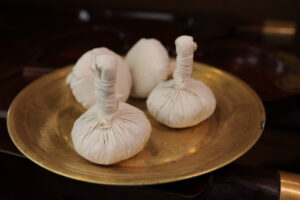
Rooksha Kizhi, also known as Podikizhi, is a dry fomentation therapy performed using heated herbal powders.
Procedure
- Herbal powders are heated uniformly.
- The powders are tied into cloth boluses.
- Warm boluses are gently massaged over the shoulder region.
Benefits
- Reduces stiffness and heaviness
- Relieves pain and restricted movement
- Improves blood circulation and shoulder mobility
3. Dhanyamla Dhara
Dhanyamla Dhara is commonly used during the initial stage when pain and inflammation are more severe.
Procedure
- Warm fermented herbal liquid (Dhanyamla) is prepared.
- The liquid is continuously poured over the affected shoulder for a fixed duration.
Benefits
- Reduces inflammation and swelling
- Relieves pain and muscle tightness
- Improves circulation and flexibility
4. Ela kizhi
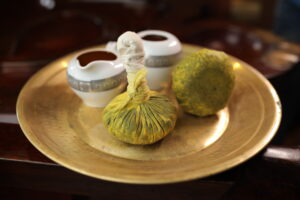
Ela Kizhi is an Ayurvedic heat therapy using warm herbal leaf bundles to relieve pain, stiffness, and restricted movement in frozen shoulders.
Procedure
- Herbal leaves are fried with medicinal ingredients and tied into cotton bundles.
- Warm medicated oil is applied over the shoulder.
- The heated herbal bundles are gently pressed and massaged over the affected area.
- The bundles are reheated repeatedly to maintain warmth during the therapy.
- Sessions usually last 20–40 minutes for several days.
Benefits
- Reduces pain and inflammation
- Relieves muscle tightness and spasm
- Improves blood circulation
- Helps increase shoulder mobility
- Reduces stiffness and heaviness
5. Naranga Kizhi
Naranga Kizhi is an Ayurvedic therapy using warm lemon and herbal poultices to reduce pain and stiffness in frozen shoulders.
Procedure
- Lemon pieces are mixed with herbal powders and rock salt, then tied securely in Kora cloth to prepare therapeutic boluses.
- Warm herbal oil is applied over the shoulder.
- The heated lemon bundles are pressed and massaged over the affected area.
- The bundles are reheated regularly to maintain warmth.
- Sessions usually last 20–30 minutes
Benefits
- Relaxes tight muscles
- Reduces pain and stiffness
- Improves blood circulation
- Enhances flexibility and shoulder movement
6. Pichu (Local Oil Application)
Pichu is a local oil retention therapy used to provide continuous soothing and nourishment to the affected joint.
Procedure
- Medicated oil is warmed mildly.
- Cotton or gauze soaked in medicated oil is placed over the shoulder joint.
- It is retained locally for a specific duration.
Benefits
- Reduces dryness and stiffness
- Relieves pain and discomfort
- Nourishes muscles and soft tissues
- Helps relax the shoulder joint
7. Ekanga Seka (Localized Pizhichil) with Murivenna
Ekanga Seka combines warm oil pouring over the affected area with gentle massage.
Procedure
- Murivenna oil is heated to a comfortable temperature.
- Warm oil is continuously poured over the shoulder region.
- Gentle synchronized massage is performed during the procedure to help relax the muscles and support local circulation.
- The treatment is performed for a specified duration based on the patient’s condition and individualized treatment plan.
Benefits
- Reduces pain and inflammation
- Relieves stiffness and muscle spasm
- Improves circulation and tissue nourishment
- Enhances shoulder mobility and flexibility
Physiotherapy Management For Frozen Shoulder
Physiotherapy plays an important role in reducing pain, improving movement, and restoring shoulder function. Treatment is usually planned according to the stage and severity of the condition.
At our hospital, we provide a structured physiotherapy-based rehabilitation program designed to reduce pain, improve mobility, and restore normal shoulder function.
1. Pain Reduction Techniques
Pain reduction is the initial goal of treatment because severe pain limits shoulder movement and daily activities.
1.1 Heat Therapy (Hot Packs)
Procedure
- Hot packs are applied over the shoulder region for approximately 15–20 minutes.
- The heat penetrates the soft tissues and helps relax tight muscles.
- It is usually given before exercises or stretching sessions.
Benefits
- Relaxes muscle spasm and tightness
- Improves local blood circulation
- Reduces pain and discomfort
- Prepares the shoulder for exercise and mobilization
1.2 Ultrasound Therapy
Procedure
- Therapeutic ultrasound uses sound waves delivered through a handheld probe.
- Gel is applied to the skin to allow smooth transmission of waves.
- The therapist moves the probe gently around the painful shoulder area.
Benefits
- Reduces inflammation
- Helps decrease pain
- Promotes tissue healing
- Improves flexibility of soft tissues
1.3 Manual Therapy
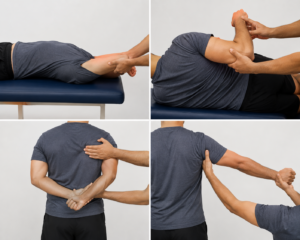
Procedure
- The physiotherapist performs gentle mobilization techniques on the shoulder joint.
- Different grades of mobilization may be used depending on pain and stiffness.
- Soft tissue release techniques may also be performed.
Benefits
- Reduces joint stiffness
- Improves joint mobility
- Helps reduce pain
- Enhances shoulder movement
2. Range of Motion (ROM) Exercises
ROM exercises are important to prevent worsening of stiffness and gradually restore normal shoulder movement.
2.1 Passive Movements
Procedure
- The therapist gently moves the patient’s shoulder without active effort from the patient.
- Movements are performed within the pain-free range.
Benefits
- Prevents joint stiffness
- Maintains joint mobility
- Reduces muscle tightness
2.2 Active-Assisted Movements
Procedure
- The patient performs shoulder movements with assistance.
- Support may be provided by the therapist, the opposite hand, or exercise equipment.
Benefits
- Encourages gradual muscle activation
- Improves movement confidence
- Enhances flexibility and coordination
2.3 Pendulum Exercise
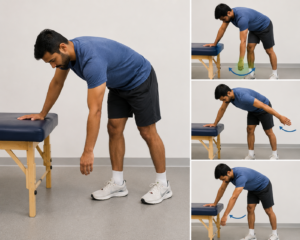
Procedure
- The patient bends slightly forward while supporting the body with the unaffected arm.
- The affected arm hangs freely.
- Gentle circular or swinging movements are performed.
Benefits
- Reduces pain and stiffness
- Promotes gentle shoulder mobility
- Helps relax shoulder muscles
2.4 Finger Walk Exercise
Procedure
- The patient stands facing a wall.
- Fingers are slowly “walked” up the wall as high as comfortable.
- The arm is gradually lowered back down.
Benefits
- Improves shoulder elevation
- Increases range of motion
- Enhances flexibility and function
2.5 Active Exercises
Procedure
- The patient independently performs shoulder movements.
- Exercises include shoulder flexion, abduction, rotation, and elevation.
Benefits
- Improves muscle control
- Restores functional movement
- Increases joint mobility
3. Stretching Exercises
Stretching exercises help improve flexibility and reduce capsular tightness.
3.1 External Rotation Stretching
Purpose
Improves outward rotation of the shoulder.
Benefits
- Reduces stiffness
- Improves ability to perform grooming and dressing activities
3.2 Forward Elevation Stretching
Purpose
Improves the ability to raise the arm overhead.
Benefits
- Helps in reaching activities
- Increases shoulder flexibility
3.3 Cross-Body Stretching
Purpose
Improves movement across the chest.
Benefits
- Enhances shoulder flexibility
- Reduces tightness around the posterior shoulder
4. Strengthening Exercises
Strengthening exercises are introduced after pain decreases and movement improves.
4.1 Rotator Cuff Strengthening
Purpose
Strengthens the muscles that stabilize the shoulder joint.
Benefits
- Improves shoulder stability
- Prevents weakness and recurrence
4.2 Resistance Band Exercises
Procedure
- Elastic resistance bands are used for shoulder movements.
- Resistance is gradually increased according to patient tolerance.
Benefits
- Improves muscle strength
- Enhances endurance and coordination
4.3 Functional Training
Purpose
Restores the ability to perform daily activities.
Activities
- Reaching overhead
- Lifting light objects
- Dressing and grooming tasks
Benefits
- Improves independence
- Restores normal shoulder function
Acupuncture for Frozen Shoulder
Acupuncture is used as a supportive treatment to help reduce symptoms and improve shoulder function.
Effects of Acupuncture
- Helps relieve shoulder pain
- Improves blood circulation to the affected area
- Relaxes tight muscles around the shoulder
- Reduces inflammation in the joint
- Supports gradual improvement in shoulder movement
Procedure
Fine, sterile needles are carefully inserted into specific acupuncture points by a trained practitioner. The treatment is designed to help relieve pain, reduce muscle tension, and support improved shoulder mobility.
Early diagnosis and a combination of physiotherapy, Ayurvedic therapies, exercise rehabilitation, and supportive treatments can significantly improve pain, mobility, and overall quality of life in individuals with frozen shoulder.
Our treatment is focused on reducing pain, improving mobility, and restoring normal shoulder function safely and effectively, helping patients return to their daily activities with greater comfort and confidence.
DISCLAIMER: The information provided in this article is intended solely for educational purposes. Treatment decisions should be made exclusively by a well-qualified Ayurvedic physician. Self-medication is strongly discouraged.
Maurya Ayurveda Hospital, opposite to Sabine Hospital, Pezhakkapilly P.O, Muvattupuzha, Ernakulam; PIN: 686673, Contact no.: 9947183000
Email: info@mauryaayurveda.com
Maurya Ayurveda Ortho & Neuro Rehabilitation Centre (Ayurveda Hospital)